‘Misery’ (1990) Review: A Classic Tale of Obsessive Fans and Parasocial Bonds
After getting into a severe automobile accident during a blizzard, a famous novelist is taken in by his “number one fan.”

Misery; Movie; Directed by Rob Reiner; Horror, Thriller; R; 1h 47m
In 1883, Arthur Conan Doyle published a new short story called “The Final Problem”, where he killed off his world-renowned character, Sherlock Holmes. Although he was mournful in the eyes of the public, behind closed doors the author personally felt he was done with the character. This decision caused major backlash that, although may sound tame to someone living in the age of the internet, was unprecedented at the time.
20,000 subscribers cancelled their subscription to Doyle’s publisher, The Strand Magazine, which almost killed the publication. American clubs called “Let’s Keep Holmes Alive” were formed in protest. People wrote letters to Strand in an outrage, demanding for Holmes to be brought back to life. Despite trying to resist the pushback, a decade later Doyle published “The Adventure of the Empty House”. The story revealed Sherlock managed to survive the deadly fall, retconning the ending of the previous work.
I bring this up as I found it interesting how similar this event was to the main conflict of Misery (1990). The story begins with a famous author named Paul Sheldon (James Caan) who’s well known for his romance novels focusing on the character of Misery Chastain. Although the series is very popular and lucrative, Paul hates it and wishes to focus on something new that would have people take him seriously as a writer. His latest Misery book kills off the main protagonist so he can do just that.

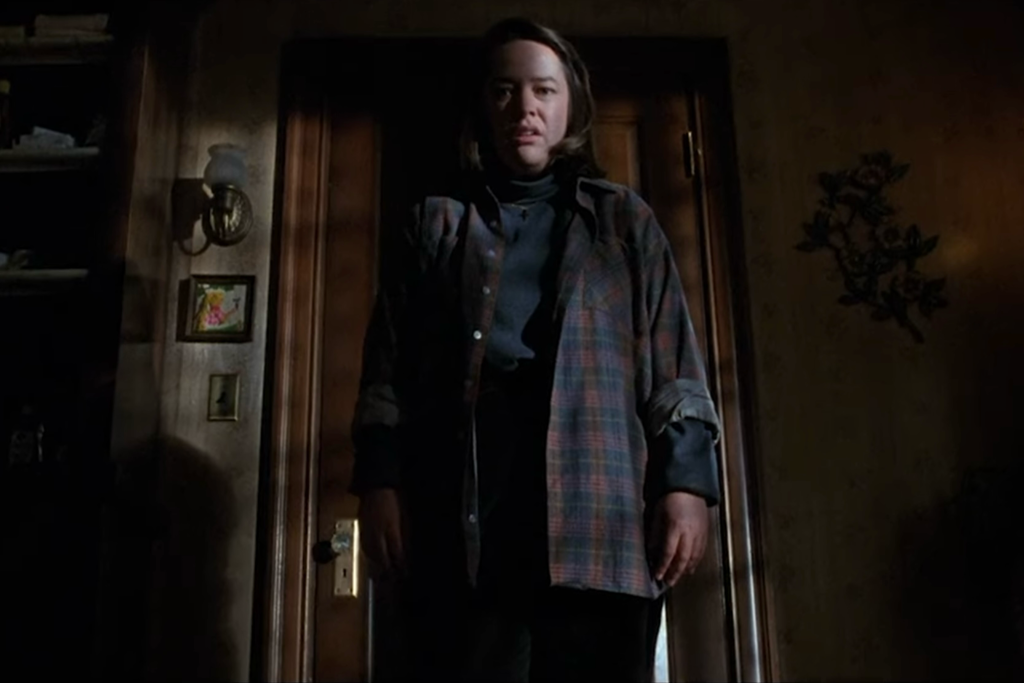
While on a drive with his manuscript for his newest non-Misery book, Fast Cars, Paul gets caught in a snowstorm and is rescued by a former nurse named Annie Wilkes (Kathy Bates). As she nurses Paul back to health, Annie proclaims she’s his “number one fan” as she’s even named her pig after the protagonist of Paul’s Misery novels.
Annie asks to read his newest work and takes great offense to it, as it’s not something she imagined Paul writing. Upon learning Paul killed off Misery in the latest Misery book, Annie gets violent and screams, “You murdered my Misery!” She reveals that she never contacted anyone about his whereabouts and threatens to kill him if he doesn’t destroy Fast Cars and write a new story where Misery lives.
Although I have not read the novel it’s adapted from, I can say with certainty that this movie is phenomenal on its own. The story was gripping with themes that still hold up to this day. All the characters were well written and had depth to them, from Paul and Annie to Sheriff Buster and Deputy Virgina, who investigate Paul’s disappearance. The camera work and lighting helped create a wonderful atmosphere of horror and uneasiness with the original score adding its own dramatic flair.

From the subtle facial expressions to the more dramatic bursts of rage, the acting for the film was incredible, with Kathy Bates being an absolute highlight. In 1991 she won the Oscar for Best Actress in a Leading Role for her performance, something she rightfully deserved. The editing was good and had some stand out moments, such as the parallel action of Paul trying to lock his bedroom door as Annie tries to unlock the front door when she comes home.
One of the biggest issues I had with the film was the audio balancing. At times it was difficult to hear the dialogue as it would get drowned out by the music. I also felt that Sheriff Buster figuring out Annie kidnapped Paul was a little too perfect as it seems to be more so a case of right place, right time and sheer luck. Another thing was how toned down the movie was from the source material.
Although I haven’t read the book, I do know it’s far more violent than the movie and has a darker ending. With that being said, I don’t dislike the movie’s ending, as it shows Paul has not (and likely will not) recover from the trauma of being held hostage by Annie. I also don’t necessarily think the movie needs to be brutal like the book to be a good film and get the point across, but it does fall flat as an adaptation in that regard.

The movie’s rhetoric, much like the book, is very blatantly about obsessive fans and the dangers of parasocial relationships. Annie loves Misery so much that she not only named her pig after the main character, but also quoted one of the books during a court case where she was being tried for murder.
But Annie isn’t just obsessed with the Misery series, she’s also obsessed with Paul himself. She knows exactly how he celebrates finishing a book and how he doesn’t make extra copies of his work because he’s superstitious (which was information he shared with someone 11 years ago). It’s when she begins to see a side of Paul she never imagined that she starts to become irate and violent.
Misery is also about how fans influence the works of an author. At the end of the film, Paul goes from wanting large publications to like his work to caring about what his fans think about it. There’s also a very literal example of this happening where Annie forces Paul to write what she wants out of the next Misery story. In order to appease her, Paul sacrifices what he wants and puts in what Annie wants to hear. This kind of fanservice and pandering often comes at the expense of the story an author is trying to tell.

Overall I greatly enjoyed Misery. I had high hopes going in and the movie absolutely delivered. With how connected everyone has become, Misery is a truly timeless tale.
Even to this day we see how toxic fans arise and cause trouble for both the authors of the work they’re obsessed with and even other fans. So long as social groups and fanaticism exist, so will this obsessive, controlling behavior. Luckily, it’s not likely your typical fanatic is a crazed killer.
Rating: 9/10

Designed with WordPress